
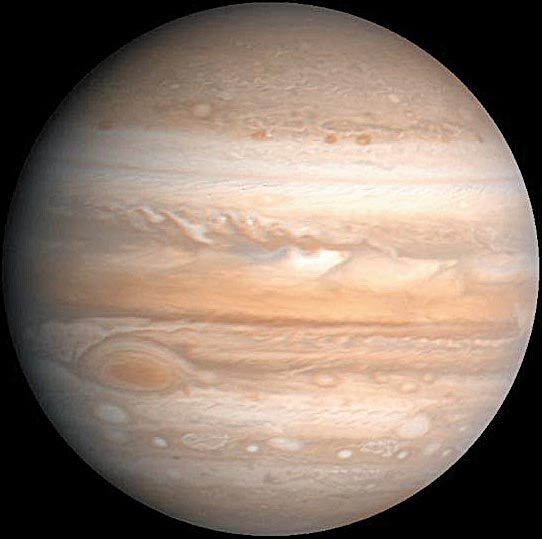
As the Great Red Spot demonstrates, Jupiter is a world of superlatives. It is the largest planet in the solar system (big enough to swallow more than 1,300 Earths, and bigger than some types of stars), and more massive than the solar system's other known planets and moons combined. It rotates faster than any other planet, it produces the most powerful magnetic field, and it offers the largest and most interesting assortment of moons.
Despite its great size and its brightness in Earth's night sky, however, much about Jupiter remains poorly understood. Scientists must infer quite a bit about it from observations by the spacecraft that have visited the planet.
Much of the mystery surrounds Jupiter's interior. From the planet's mass, density, and magnetic field, scientists surmise that it probably has a dense core at least 10 times as massive as Earth. Observations by the orbiting Juno spacecraft, however, suggest that the core is "melty" — perhaps solid in the middle, but more viscous at the perimeter.
A thick layer of hydrogen surrounds the core. Jupiter's gravity squeezes this layer so tightly that it acts as a metal. The metallic hydrogen probably rotates at a different speed from the core, so it produces a "dynamo" effect, generating electric currents that create Jupiter's magnetic field.
Layers of hydrogen and helium gas surround the metallic hydrogen, and a relatively thin layer of clouds envelops the entire planet. (This layer is actually hundreds of miles thick, but compared to Jupiter's great size, that's like the skin on an onion.) Jupiter's rapid rotation stretches the clouds into narrow bands that circle the entire planet.
The bands show different colors, which means their clouds are made of different materials and hover at different altitudes. The highest layers of clouds, which are white, are made of frozen ammonia. Clouds in the next layer contain ammonia mixed with other chemicals, so they look brown or orange. The lowest layers contain water vapor and water ice, so they look blue.
These bands form alternating light and dark stripes. The light-colored stripes are decks of clouds that are pushed high into the atmosphere by rising bubbles of warm gas. The darker stripes consist of cooler material that is dropping back into the planet's atmosphere.
Much of the weather in these zones draws its energy not from the Sun, as is the case with storms on Earth, but from deep within Jupiter itself. As Jupiter's gravity squeezes the planet, it produces heat that wells up through the atmosphere then escapes into space as infrared energy. Jupiter radiates more energy into space than it receives from the Sun.
Rings encircle Jupiter, although they are far darker and skimpier than those of the flashier planet Saturn. The rings may consist of material that was "sandblasted" off the surfaces of Jupiter's moons by collisions with meteorites.
Since Jupiter has no solid surface, no human will ever walk on the planet. In fact, any attempt to visit the Jovian system will require heavy shielding. Jupiter's magnetic field captures electrically charged particles from the Sun and from the planet's volcanic moon Io. These particles create strong radiation belts. Around Io's orbit, the radiation belts are powerful enough to kill an unprotected human in a few minutes. That adds one more item to the list of Jupiter's superlatives: deadliest radiation belts.